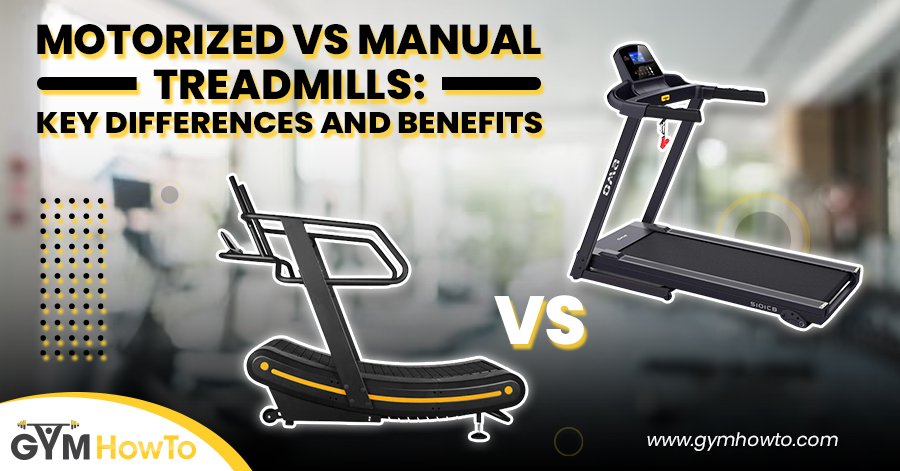
Short answer: For most people, a motorized treadmill is the better buy. It's easier to use, better for running, and offers speed/incline control. Manual treadmills cost less upfront and need no electricity, but budget flat-belt models feel awkward — and the good curved manuals cost $2,000+.
- Motorized treadmills are the best choice for most users — they support walking, jogging, and running with precise speed and incline control.
- Budget manual treadmills ($100–$300) are for walking only — they feel stiff and awkward for running.
- Curved manual treadmills ($2,000–$5,000) are elite athlete tools — they burn 30% more calories but are heavy, expensive, and don't fold.
- If you have $300–$500 to spend, a motorized treadmill is the most versatile and useful investment for a home gym.
Here's the full breakdown so you can decide which type fits your treadmill needs.
Motorized vs Manual Treadmill: Quick Comparison
| Factor | Motorized Treadmill | Manual Treadmill (Flat-Belt) | Manual Treadmill (Curved) |
|---|---|---|---|
| Price range | $200–$3,000 | $100–$300 | $2,000–$5,000 |
| Best for | Walking, jogging, running | Walking only | Sprints, HIIT, athletic training |
| Speed control | Set exact speed with buttons | You control pace with your stride | You control pace with your stride |
| Incline | Auto-incline on most models | Fixed or manual adjustment | Curved surface replaces incline |
| Noise level | Moderate — motor hum + belt | Quiet — no motor | Quiet — no motor |
| Electricity | Required | None | None |
| Belt feel | Smooth, consistent | Stiff, can feel jerky | Smooth, responsive |
| Calorie burn | Standard | Similar to motorized | Up to 30% more than motorized |
| Maintenance | Belt lubrication, motor service | Minimal | Minimal |
| Folding options | Many models fold | Most fold | Typically don't fold |
| Weight | 50–130 lbs | 25–60 lbs | 250–350 lbs |
Motorized Treadmills
A motorized (electric) treadmill uses an electric motor to drive the belt at a set speed. You choose the pace, and the belt maintains it. This is the type you see in commercial gyms and the type most people picture when they think "treadmill."
Why motorized is usually the right choice
Consistent pacing. You set 6.0 mph and the belt runs at 6.0 mph. This is essential for structured training — intervals, tempo runs, or progressive speed work. You can't get this precision with a manual belt.
Running is viable. Motorized treadmills have wider, longer belts (typically 20" × 55–60") and smooth belt action that makes running comfortable. Budget manual treadmills have short, narrow belts that feel choppy above walking speed.
Auto-incline changes the workout. Walking at 3.5 mph on a 12% incline burns roughly the same calories as jogging at 5.5 mph on flat — with far less joint impact. Most motorized treadmills above $300 include auto-incline up to 10–15%.
Preset programs keep you engaged. Hill intervals, fat burn zones, heart rate training — these programs vary your speed and incline automatically so you don't have to think about it.
When motorized isn't ideal
- Noise. Motor hum + belt contact + your footfall = noticeable noise. Not ideal for apartments with thin floors or late-night use.
- Electricity required. You need an outlet, and energy costs add up slightly over time.
- Maintenance. The belt needs periodic lubrication (every 3–6 months), and motors can eventually fail on cheaper models.
- Size and weight. Even folding motorized treadmills are heavy (60–130 lbs) and take up space.
Manual Treadmills
A manual treadmill has no motor. The belt moves only when you push it with your feet. There are two very different types, and the distinction matters a lot.
Flat-belt manual treadmills ($100–$300)
These are the cheap, lightweight manual treadmills you see on Amazon. The belt is flat and requires significant force to start moving. They work for slow walking but feel stiff and unnatural at any speed above 3 mph.
The honest take: These are fine for walking-only use on a strict budget. They're light (25–50 lbs), fold small, and cost under $200. But if you want to jog or run, they're frustrating. The belt resistance is inconsistent, the stride feels choppy, and most people stop using them within a few months.
Curved manual treadmills ($2,000–$5,000)
Curved manual treadmills (TrueForm, Assault AirRunner, Woodway Curve) are a completely different category. The concave belt surface lets the belt accelerate naturally as you lean forward and run. Speed is entirely controlled by your effort — lean forward to speed up, lean back to slow down.
Why athletes love them: Curved manuals can burn up to 30% more calories than motorized treadmills at the same perceived effort because you're doing all the work. They train natural running mechanics (forefoot strike, shorter stride) and require zero electricity.
Why most home gym users should skip them: They cost $2,000–$5,000. They weigh 250–350 lbs and don't fold. The running feel takes significant adjustment — your first few sessions will feel extremely hard. These are specialist tools for athletes, CrossFit boxes, and sprint training. They're not casual walking treadmills.
Which Should You Buy?
Buy a motorized treadmill if:
- You want to walk, jog, and run on the same machine
- You value speed and incline control for structured workouts
- Your budget is $300–$1,000 (the sweet spot for home treadmills)
- You want auto-incline for low-impact, high-calorie-burn walking
See our best treadmills under $200 for budget motorized options, or our best treadmills under $500 for the price range we recommend most.
Buy a flat-belt manual treadmill if:
- You only walk (no jogging or running)
- Your budget is under $200
- You need something light and portable (apartment, small space)
- You want a treadmill that works without electricity (garage, outdoor patio)
Buy a curved manual treadmill if:
- You're an athlete training for sprints or HIIT
- You have $2,000+ to spend and the space for a 300 lb machine
- You specifically want to improve running mechanics
- You train at a CrossFit box or performance gym that already has one
The Bottom Line
For the vast majority of home gym users, a motorized treadmill between $300 and $500 is the right call. It handles walking, jogging, and running with proper speed/incline control, folds for storage, and costs a fraction of a curved manual.
Budget flat-belt manuals are a reasonable compromise for walkers on a strict budget. Curved manuals are excellent machines, but their price and size make them impractical for most home setups.
Don't overthink this. If you'll primarily walk, a $150 manual works. If you'll jog or run, spend $300+ on a motorized model. Everything else is a marginal difference.